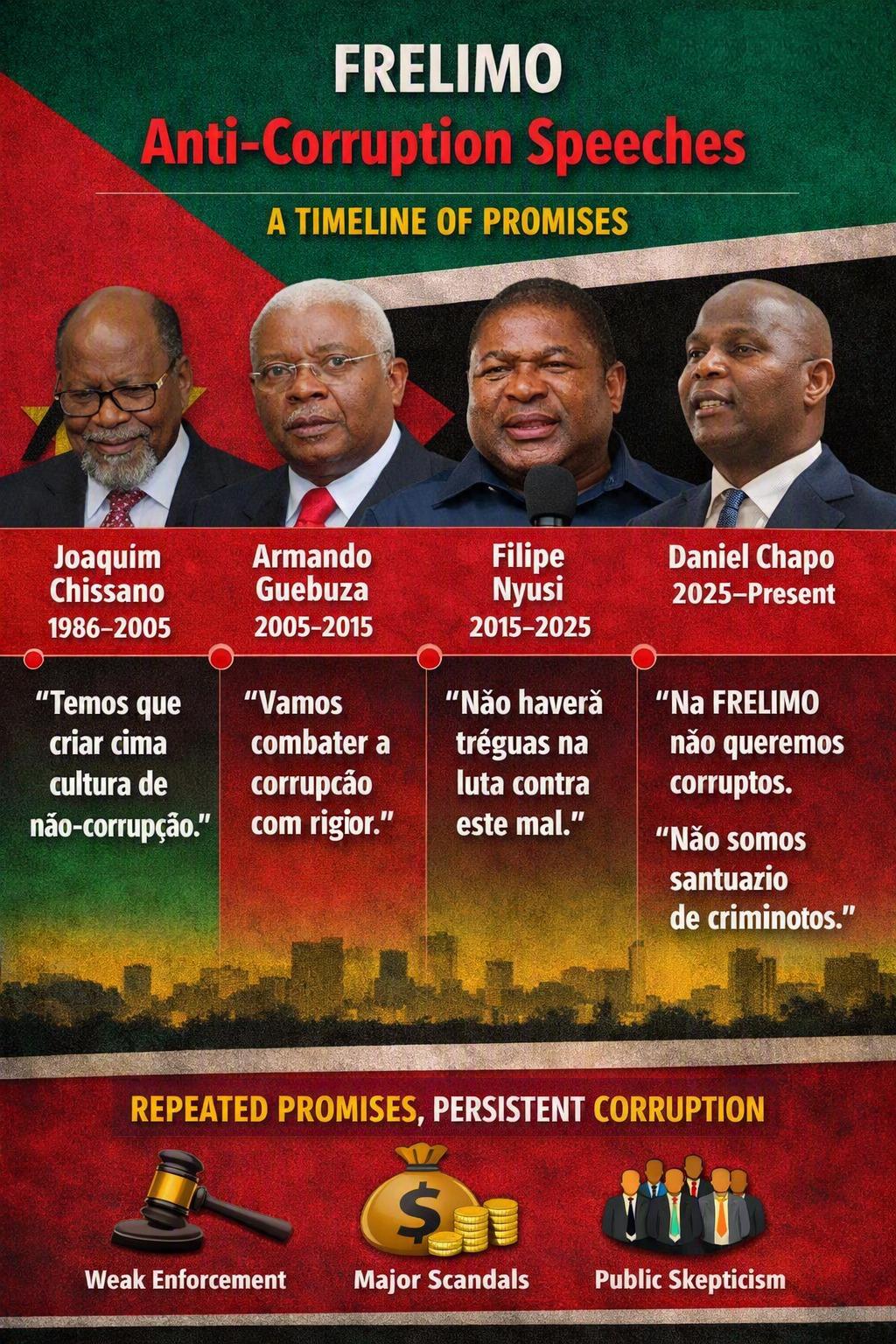
As the curtains were drawn on the ruling Frelimo party’s 11th National Cadres Conference, in the city of Chimoio, in central Mozambique, President Daniel Chapo declared: “In Frelimo, we do not want corrupt people. We are not a safe haven for criminals.”
He insisted that the party must “shake the tree until the rotten fruit falls,” presenting himself as the leader of a “New Era” in which corruption would be uprooted and integrity restored. Delivered before party cadres and broadcast nationally, the statement was framed as a moral turning point for Frelimo.
Within hours, Frelimo supporters had viralised Chapo’s words across social media platforms, turning the phrase into a rallying cry. Memes, video clips, and celebratory posts flooded WhatsApp groups and Facebook timelines, amplifying the message as proof of moral renewal and discipline. The party’s communication machinery seized on the moment, projecting Chapo’s words as a sign of strength and unity.
Comment
Yet Chapo’s words fall into a long tradition of anti‑corruption rhetoric that has defined Frelimo presidencies since Joaquim Chissano. Chissano launched Mozambique’s first Public Sector reforms with a focus on fighting corruption. Armando Guebuza promised “We’ll tackle corruption with vigour,” but his era became synonymous with opacity and the hidden debts scandal. Filipe Nyusi vowed “There will be no let-up in the fight against this evil (corruption)” yet civil society judged his speeches “hollow and empty,” as systemic corruption persisted.
Chapo’s statements, therefore, echo his predecessors. The difference is that corruption has now become endemic, shaping political advancement itself: to become a member of parliament or of the party’s Central Committee, candidates must buy votes, with exception of those who the president himself wants to see elected – even then, voting is manipulated so that the person might win. Some critics said jokingly that “hardly anyone who went to Chimoio would have returned home if they were to put into practice what Chapo said,” but would be shipped to jail. What was once scandalous has spilled into society and become normalised, eroding institutions and rewriting the social contract around complicity.
Against this backdrop, Chapo’s rhetoric appears less a rupture than a political tool. It placates discontent in a country where frustration is mounting, co‑opts the opposition’s discourse, particularly that of ANAMOLA (National Alliance for a Free and Autonomous Mozambique), whose anti‑corruption message resonates with citizens, and reframes corruption as the fault of “a few rotten fruits” rather than a systemic rot implicating the party from top to bottom.
The cycle is clear: each president promises renewal, each faces scandals, and each leaves behind deeper skepticism. Chapo’s “New Era” risks being read as another ritual of words; a performance designed to reassure the electorate and blunt opposition critique, while leaving intact the machinery of patronage and impunity that sustains Frelimo’s power.
As such, renewal cannot coexist with systemic corruption. The true test of Chapo’s “New Era” lies not in speeches, but in whether Frelimo can dismantle the entrenched networks that have made corruption its lifeblood. Until then, the rhetoric will remain a mask, pulling wool over the eyes of discontent Mozambicans.
@2026, Mozambique Insights. All Rights Reserved