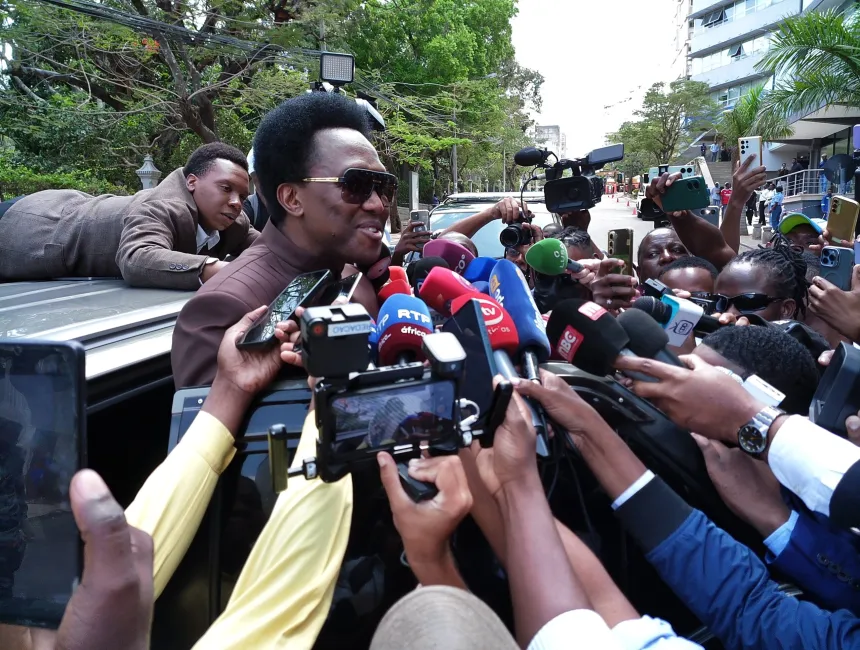
Venâncio Mondlane on Monday pushed back against claims that his public rhetoric fuelled post-election violence in Mozambique, telling the court that his social media messages were intended as political mobilisation rather than operational instructions for his supporters.
Mondlane made the denial under questioning by a legal representative of the Rede Viária de Moçambique (REVIMO), in a hearing that brought into sharp focus the boundaries between political mobilisation and responsibility for the actions of others.
Mondlane accepted the responsibility for convening the demonstrations but denied the existence of organised structures acting under his direction. The former presidential candidate also rejected suggestions that the phrase “Turbo V8”, which he used during his social media live streams, referred to any concrete operation, describing it instead as an expression used during a particularly tense political moment.
He further denied maintaining networks of informants within public institutions and disputed claims that his supporters were involved in the destruction of public infrastructure during the post-election unrest. According to his testimony, such acts were carried out by individuals or groups seeking to undermine the protests themselves.
The hearing also examined a number of Mondlane’s public statements relating to deaths that occurred during the protests. He maintained that he had consistently condemned the killing of both police officers and demonstrators, describing both as unacceptable. Asked about remarks in which he vowed to “terrorise the terrorists, murderers and thieves”, Mondlane said the phrase was intended as a form of political and social pressure, exercised through public scrutiny, civic protest and debate rather than violence.
The trial will now move into the defence phase of the questioning, at a moment when the proceedings appear increasingly focused on a central issue: whether a legally demonstrable link exists between Mondlane’s public statements and the violence that marked the post-election demonstrations.
Comment
Monday’s hearing marked a significant shift in the centre of gravity of the trial. Previous sessions were largely concerned with specific statements, recordings, protests and events. This time, however, the discussion revolved around a more difficult and consequential question: to what extent can a political leader be held responsible for actions committed by people who claim to act in line with his political message?
Mondlane’s defence appears to rest on a clear distinction between political mobilisation and operational control. By accepting ownership of the calls for protest while denying any role in directing violence or destruction, he is attempting to draw a firm line between rhetoric and execution. At the same time, the line of questioning pursued during the hearing suggests that a substantial part of the case may depend not only on what was said, but on how the effects of those statements are interpreted in legal and political terms. The issue is no longer simply whether violence occurred, something that is well documented in the aftermath of the election. It is whether a credible and
demonstrable nexus can be established between those events and the public messages issued by the former presidential candidate.
This is a particularly sensitive issue in any democracy. Courts are often called upon to determine when political speech amounts to legitimate expression, mobilisation and protest, and when it may cross into incitement, encouragement or facilitation of unlawful acts committed by others. It is precisely along this fault line that the trial now appears to be unfolding. More than any debate about slogans, catchphrases or figures of speech, Monday’s proceedings highlighted the question that may ultimately lie at the heart of the court’s decision: can the political responsibility of a leader be separated from responsibility for acts carried out in his name? The answer could prove as important for the future of Venâncio Mondlane as it is for defining the limits of political
dissent and democratic mobilisation in Mozambique.
@2026, Mozambique Insights. All Rights Reserved