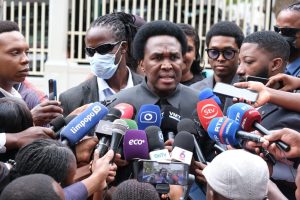
The second day of the trial of Venâncio Mondlane, a Mozambican opposition politician, was dominated by disputes over evidence, procedural disagreements, and a forceful rejection by the defendant of allegations that he sought to overthrow the government. At the centre of the proceedings was a contested telephone recording that prosecutors say supports accusations of attempts to undermine the constitutional order and prepare terrorist acts.
Mondlane, a former presidential candidate, used part of the hearing to challenge the prosecution’s case directly, questioning which specific actions were being attributed to him and how those actions corresponded to the crimes listed in the indictment. His defence team meanwhile focused on challenging the legality and reliability of the prosecution’s key evidence.
The hearing began with the Public Prosecutor’s Office objecting to the failure to read and sign the minutes of the previous session. Prosecutors also renewed their challenge to the participation of Chamir Mendes in the defence team, arguing that he does not possess the professional qualifications required to practise law. The court upheld its earlier position, allowing Mendes to remain part of the defence team. However, he cannot serve as lead defence counsel and is not authorised to present arguments before the court.
The defence challenged the admissibility of a telephone recording that prosecutors consider key evidence, arguing that its legality and authenticity have not been established. Citing alleged procedural and evidentiary gaps, including questions over how the recording was obtained and verified, the defence asked the court to exclude it from the case.
Later, Mondlane addressed the court directly, maintaining that his extensive use of social media during the post-election protests was part of a campaign challenging the 2024 election results and alleged irregularities. He firmly rejected accusations that he intended to organise, support, or encourage a coup détat.
Comment
The significance of the second day lies less in any new revelation than in the growing importance of the evidentiary battle now unfolding in court. The prosecution’s broader case appears to rely heavily on establishing that political mobilisation after the 2024 elections crossed the line into criminal conduct.
The disputed telephone recording seems to be one of the key pieces of evidence intended to support that argument. If the court ultimately finds weaknesses in its legality, chain of custody, or authenticity, the prosecution could face a much higher burden in connecting political rhetoric and protest activity to the serious offences alleged.
Equally notable is Mondlane’s insistence on asking the court to identify the specific actions that constitute the alleged crimes. This reflects a broader legal challenge often seen in politically charged cases: distinguishing between conduct that may be controversial or confrontational and conduct that satisfies the legal threshold for offences against the state. The defence’s strategy appears increasingly focused on forcing the prosecution to demonstrate not only intent, but also concrete acts that fulfil the
elements of the crimes charged.
The proceedings therefore seem to be moving beyond the political narratives that have dominated public debate since the disputed 2024 elections. The central questions are becoming more narrowly legal: whether the evidence is reliable, whether it was lawfully obtained, and whether the conduct alleged amounts to criminal activity rather than political opposition. How the court addresses those questions is likely to shape not only the outcome of the trial, but also public perceptions of judicial independence, due process, and institutional credibility in Mozambique
@2026, Mozambique Insights. All Rights Reserved