At the 11th National Cadres Conference of Mozambique’s ruling Frelimo party, held recently in Chimoio, the capital of the central province of Manica, President Daniel Chapo said that the party would not be “a sanctuary for criminals” and that it was necessary to “shake the tree until the rotten fruit falls”.
His words were pitched as the dawn of a New Era, a fresh start in which corruption would finally be confronted and integrity restored to public life. Frelimo sold it as promise of change, a pledge that the party would at last take tougher action against the practices that have, year after year, chipped away at the credibility of both Frelimo and the state itself.
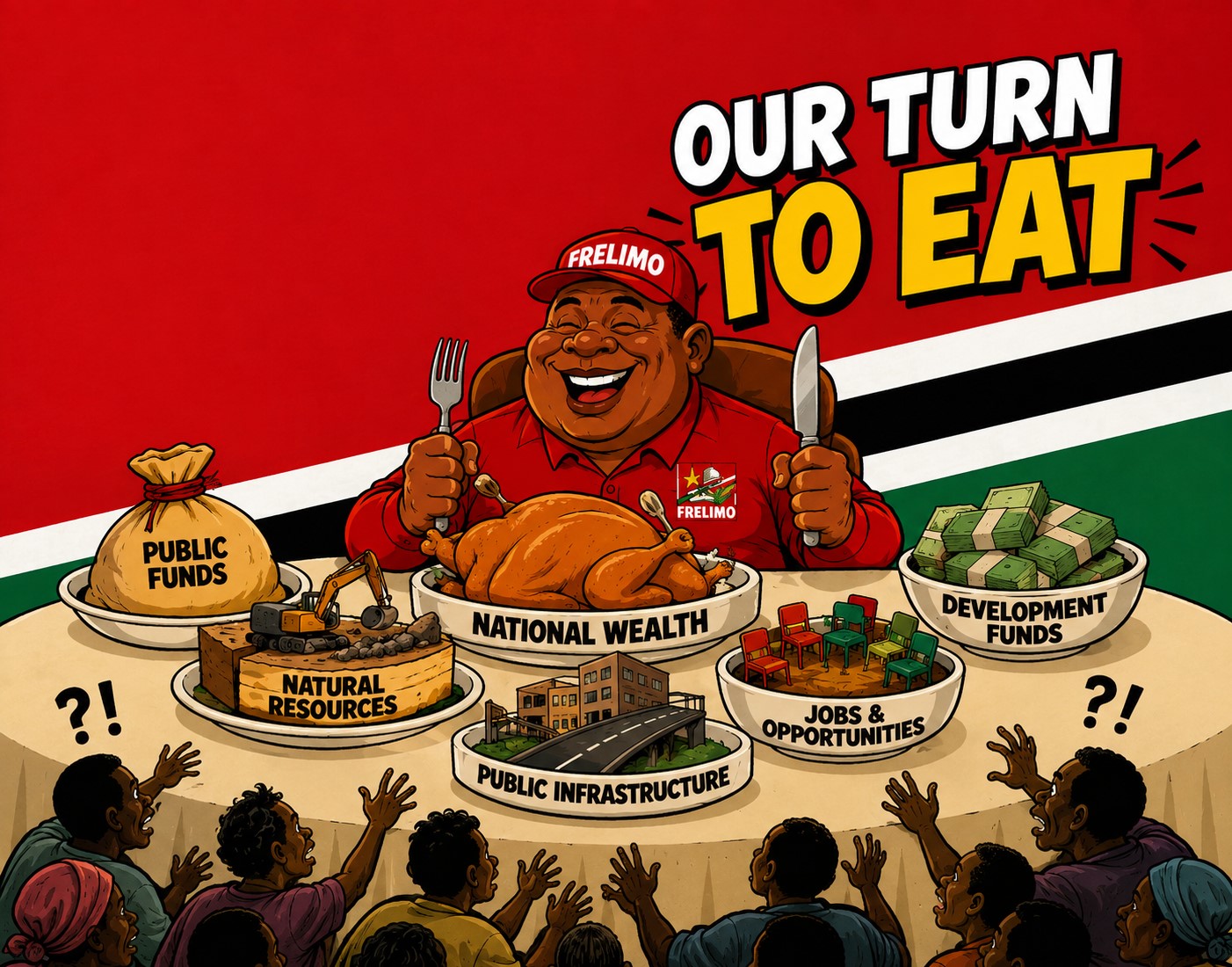
Still, for all the strong words, the meeting sidestepped the question that many see as the heart of the matter: when will there be a genuine pact to end the politics of the belly? It is the old logic that every new government cycle becomes another chance for “our turn to eat”, a cycle of private gain dressed up as public service.
Comment
The politics of the belly has become a quiet tradition, woven into every presidential cycle. Each new leader arrives with their own economic arrangements and, before long, finds themselves caught in webs of business interests and political and criminal mafias. What should be public service turns into private gain, and ministries are transformed into lucrative spaces where businessmen wear the mask of public servants.
In Chapo’s government, at least five ministers run companies in the very sectors they are meant to regulate. The danger of conflict of interest could not be clearer: the same people who draft public policy are also positioned to benefit from contracts and licences. For example, the newly appointed governor of the Bank of Mozambique, Felisberto Navalha, still holds shares in consultancy and agro‑business firms. Even the First Lady appears in company records. For many, these details confirm the suspicion that public office has become less a duty of service and more a gateway to private profit.
Take the case of the Minister of Mineral Resources and Energy, Estevão Pale. He and his family are tied to eleven mining companies, some of which were granted prospecting licences before they were even legally registered. It is a striking example of how the line between political power and private business can be blurred, bending institutional rules and opening the door to influence‑peddling.
Another telling case is that of the Minister of Transport and Logistics, João Matlombe. He is the founder of CITI Transportes, a company set up to work directly with government and municipalities on public transport projects. The overlap between his public role and his private interests is hard to ignore, and it undermines the credibility of tenders and procurement processes that should be impartial.
Furthermore, his ministry recently awarded a 25‑year public‑private partnership to two Chinese firms for the construction and operation of the new one‑stop border post at Machipanda, the gateway linking Beira to Zimbabwe’s interior. The decision highlights how strategic contracts in the transport sector are granted under his watch, while his own company remains positioned to benefit from the same policy environment he controls.
In agriculture, the story is similar. Roberto Mito Albino, now Minister of Agriculture, built up business interests while chairing the Zambezi Valley Development Agency. He created two companies in the agrarian sector, and one of them (Donawafika Investiments Mozambique) later secured service contracts with the very ministry he went on to lead. The arrangement raised serious questions of conflict of interest and exposed how easily the boundary between public office and private business can be bent for personal advantage.
The Minister of the Interior, Paulo Chachine, adds another layer of concern. In 2021 he set up a company dealing in the import and export of firearms. For a man charged with safeguarding internal security, involvement in the arms trade raises serious questions. It is a sector where acquisitions are often made by direct award, without public scrutiny, and the overlap between private business and sovereign responsibility leaves the state dangerously exposed.
This pattern is not new. Under Filipe Nyusi, Minister Carlos Mesquita became a striking example of the politics of the belly. While heading Transport and Communications, his company benefited from state transport contracts. Later, as Minister of Public Works, his daughter’s firm secured emergency works on the EN1 worth more than 600 million meticais. The Mesquita case shows how business arrangements recycle themselves from one cycle to the next, with no genuine rupture.
The Minister of Veterans, Nyeleti Mondlane, is also tied to companies in transport, commerce and mining. Her ventures alongside the children of former presidents reinforce the sense that political power is used to cement family and party business networks.
João Machatine, now Executive Coordinator of the Presidential Office for Reforms and Strategic Projects, began as a businessman in construction, engineering, energy and consultancy, with stakes in firms like Clínica das Construções, Enersol, Alplametria and Tovisi Moçambique. Later, as Minister of Public Works, he oversaw major infrastructure projects, including roads, bridges and the concession of the new Tete Bridge. Today, his role places him at the centre of reforms and concessions – the very areas tied to his earlier business interests – raising uneasy questions about where private networks end and state power begins.
Completing the picture is Ricardo Sengo, Minister in the Presidency for Civil Affairs. He is a shareholder in companies spanning mining, energy, transport, agriculture and tourism. The sheer breadth of his business interests illustrates how private accumulation stretches across multiple strategic sectors, creating conflicts of interest in areas that should be safeguarded by impartial governance.
This is not just about individual gain. It is a system, a rhythm that repeats itself with every political cycle. Each new government becomes an economic cycle too, with elites taking turns to seize resources and opportunities. It is the familiar refrain of “our turn to eat”, whispered like a mantra inside the structures of power.
Unless Frelimo makes a clear pact to break this pattern, Mozambique will remain a country rich in resources but locked out of development. The historic chance to turn wealth into social progress is slipping away, while the state stays hostage to elites who confuse political authority with private accumulation.
The New Era will only carry weight if it comes with concrete steps to separate private business from public governance. Without that, each cycle will be nothing more than a replay of the same machinery: promises of renewal, but practices that keep the politics of the belly alive.
What the country needs now is political courage. It is not enough to speak of corruption in vague terms. The heart of the problem must be faced directly: the capture of the state by the business interests of its own rulers.
Without such a pact, Mozambique will remain caught between promise and disappointment: a nation blessed with resources, yet held back from true development. Rich in potential, but poor in the progress its people deserve.
@2026, Mozambique Insights. All Rights Reserved