The latest report from Mozambique’s Financial Intelligence Unit (GIFiM) is not just another technical document on suspicious transactions. It is, in effect, a stress test of the reforms that enabled the country to exit the FATF (Financial Action Task Force) Grey List in 2025, and a reminder that credibility doesn’t come with a lifetime guarantee but as an ongoing commitment to transparency and enforcement.
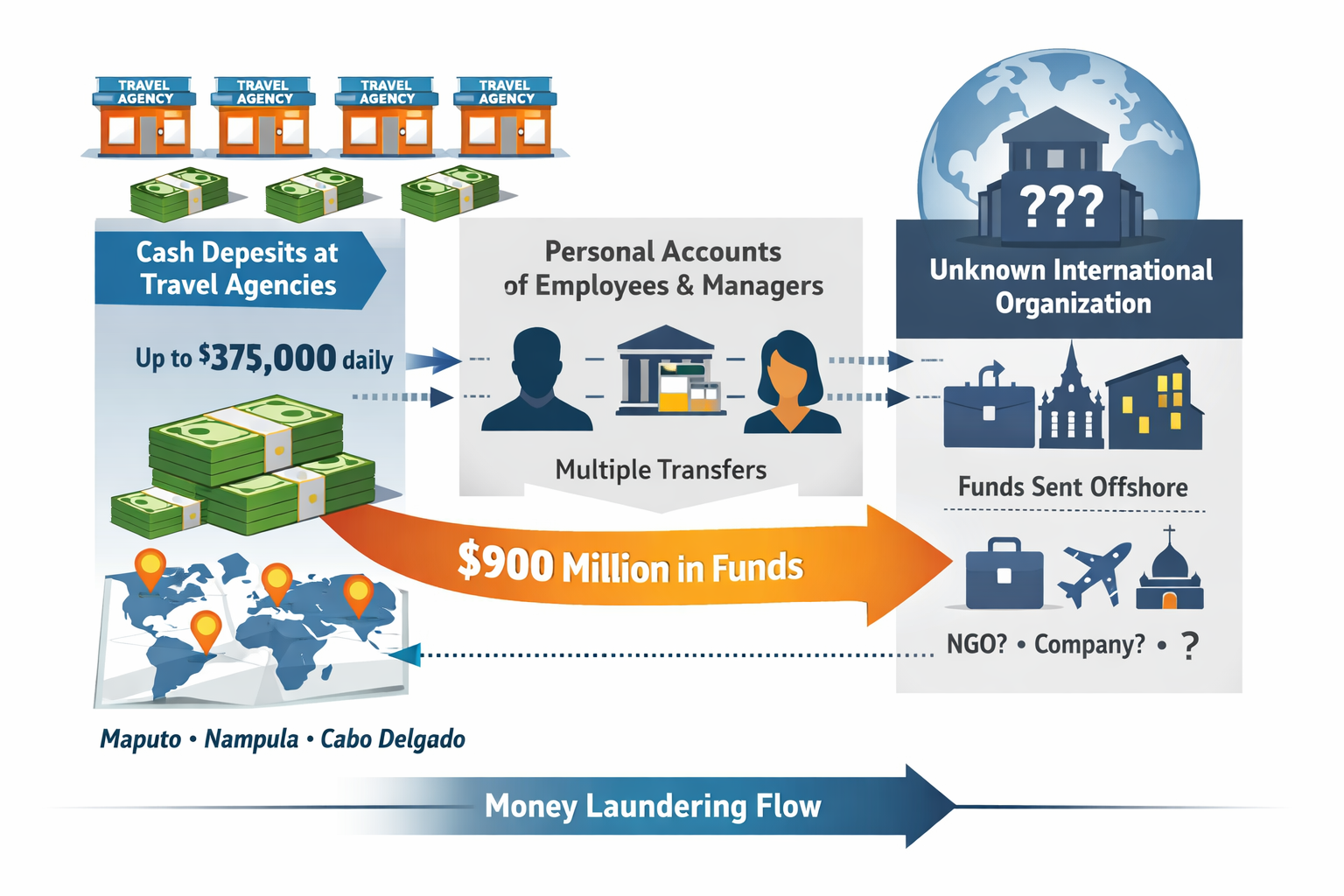
The picture painted by the report is unsettling. These travel agencies – businesses that normally rely on electronic payments and card transactions – were suddenly handling mountains of cash, with deposits reaching 24 million meticais a day, about $375,000. And over the full period examined, the money flowing through them added up to more than 58 billion meticais, roughly $908 million. It’s an extraordinary volume for a sector that, under normal circumstances, simply doesn’t operate this way.
What is more, the report reads that “several agencies received large amounts of cash, with daily deposits reaching around 24 million meticais […] afterwards, the funds were transferred to the bank accounts of an international organisation that is not identified.”
It is clear that the scale and pattern of the operations are incompatible with normal business activity. Yet the report does not identify the companies involved, their managers, or the international organisation that received the funds. This silence is understandable from an intelligence standpoint, but it raises questions that deserve to be asked; especially at a moment when Mozambique is working to prove that its reforms are substantive, not cosmetic.
Why does GIFiM not disclose the identity of the international beneficiary? The most plausible explanation is procedural: the entity may be under international investigation, and premature disclosure could compromise cooperation requests or ongoing surveillance. Another possibility is that the organisation operates under sensitive legal cover, meaning that it could be a non-governmental organisation, a logistics company, a religious entity: categories often exploited to disguise illicit flows. The omission may be justified, but it leaves a black hole that invites speculation.
Why are the five travel agencies responsible for nearly half the funds not named? GIFiM’s mandate is to flag risks, not to accuse publicly. Still, the absence of names shifts the burden onto the Attorney General’s Office (PGR) and criminal investigators. If financial intelligence does not translate into prosecutorial action, Mozambique risks undermining the very credibility it worked to rebuild.
And what about politically exposed persons? The report mentions their involvement but offers no detail. However, this could be strategic: avoiding political interference or protecting ongoing investigations, or it could indicate indirect involvement through relatives, business partners, or intermediaries. Either way, the reference is enough to raise alarms.
More importantly, the report hints at a deeper truth: the reforms are functioning, but they are not yet sufficient. The detection of the scheme shows that surveillance mechanisms are active; the fact that the scheme operated for years shows that structural vulnerabilities remain, particularly around cash-based transactions and low-supervision sectors.
Exiting the Grey List was celebrated as a political and technical victory. But this report reminds us that the real test begins after the celebration. International credibility isn’t earned by passing reforms on paper; it’s earned by what actually happens: real investigations, real prosecutions, real recovery of stolen assets, real accountability
If this case ends like so many others – without judicial consequences, without identification of beneficial owners, without recovery of illicit assets -, Mozambique risks not only the scepticism of international partners but also the erosion of domestic trust in its financial system.
GIFiM has done its part: it detected, analysed, and signalled. Now the PGR, SERNIC (National Criminal Investigation Service), and financial regulators must do theirs. Because in the fight against money laundering, leaving the Grey List is not an achievement. Staying out of it is.
@2026, Mozambique Insights. All Rights Reserved