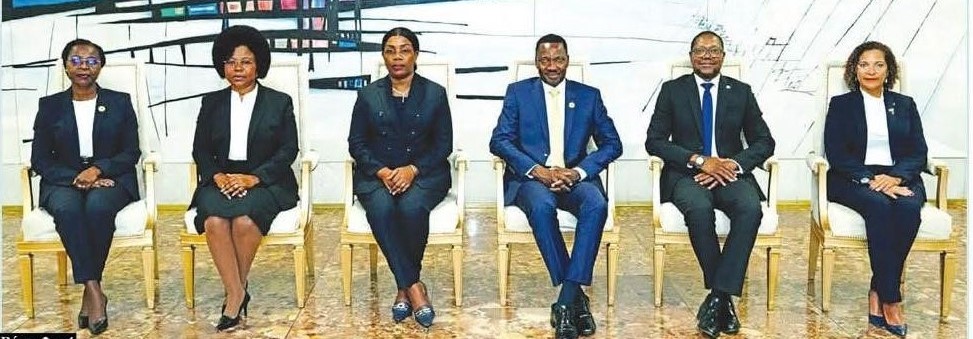
Six top board members of Mozambique’s central bank, Banco de Moçambique, including Governor Rogério Zandamela, earned 340.5 million meticais (about $5.32 million) in 2025, according to the weekly independent newspaper Canal de Moçambique.
Canal de Moçambique claims that 300 million came directly from the central bank, and 40.5 million from associated entities such as Kuhanha, SIMO, Afreximbank, and SWIFT.
Each board member reportedly received 4.7 million meticais per month, a figure that represents a 340% increase compared to the remuneration structure Zandamela inherited. When he arrived in September 2016, the BM had nine top managers with a combined annual salary budget of 99 million meticais. Under his mandate, fewer people earn more than triple the previous total.
The revelations come at a time when the Mozambican economy faces persistent inflationary pressures, a weakened metical, and chronic fiscal constraints, raising questions about governance, accountability, and the political economy of public institutions.
Comment
The Banco de Moçambique salary explosion is not an aberration. It is a symptom of a deeper structural pattern: every subsector of the public sector in Mozambique has been known for engineering its own mechanisms to extract value from the state, often under the cover of technocratic necessity, institutional autonomy, or outright rent-seeking.
This is the country’s political economy in slow motion: a choreography of insiders, networks, and cycles of enrichment that are often tied to presidential transitions. Basically, what changes are the beneficiaries but not the logic.
If anything, the “hidden debt” scandal showed how individuals within the security sector used procurement opacity to fatten their bank accounts; or how the infrastructure sector uses over-invoicing and politically connected contractors; or how the public servants charge a “fee” to the citizen to carry out their normal jobs, among others.
So, it is clear that they are institutionalized extraction models, each adapted to its own ecosystem. What the Banco de Moçambique case exposes is the public financial sector version of the same logic.
Observers point out that the justification is likely to be “international competitiveness”, that is, the claim that central bank executives must be paid at global levels. But it is not like Mozambique is an advanced economy; in fact, it is a low-income country marred by chronic fiscal stress, donor dependence, and a fragile macroeconomic environment. Therefore, the salaries are a calculated method for syphoning wealth, not the natural outcome of a competitive economy.
@2026, Mozambique Insights. All Rights Reserved