A video filmed on 18 July in Xinavane, 136 km north of Maputo, shows a violent confrontation between a unit of the riot police (UIR) and a man later identified by the police as Narciso Sambo. In the footage, Sambo struggles as officers attempt to restrain him. During the scuffle, one officer steps back, draws his firearm, and shoots Sambo several times in the head at close range. The officers then leave the scene, abandoning his body on the floor.
In a press release issued on 19 July, the Police General Command confirmed the operation, stating that Sambo was “a known offender considered highly dangerous to the public” and that he was wanted by SERNIC (National Criminal Investigation Service) for crimes including homicide, sexual assault, armed robbery, and kidnapping. The statement acknowledges that “the tense and complex nature of the operation escalated to the use of firearms, ending in the suspect’s death.”
The police further note that the incident occurred in a public space and express regret that “the police intervention meant to contain the suspect ended in his death.” The press release also mentions that, given “indications that the officers acted with excessive zeal”, an internal investigation will be opened to determine the circumstances and accountability.
The video has sparked widespread public concern, with civil society organisations calling for an independent inquiry and questioning the proportionality of the force used.
Comment
There is something profoundly unsettling about watching a human being killed in front of you, even if behind a screen. The Xinavane video is not just another incident in the news cycle; it is a moment that forces us to confront the fragility of life and the immense power the police seem to wield over ordinary citizens. It also forces the question of why, once again, a Mozambican citizen has died at the hands of the police in circumstances that appear to violate every principle of lawful policing.
So far, that question produces a particular kind of silence that follows an extrajudicial killing; a silence filled with shock, anger, and a sense of helplessness. The Xinavane video has produced exactly that silence. It is not just the brutality of the act that unsettles; it is the familiarity of the pattern.
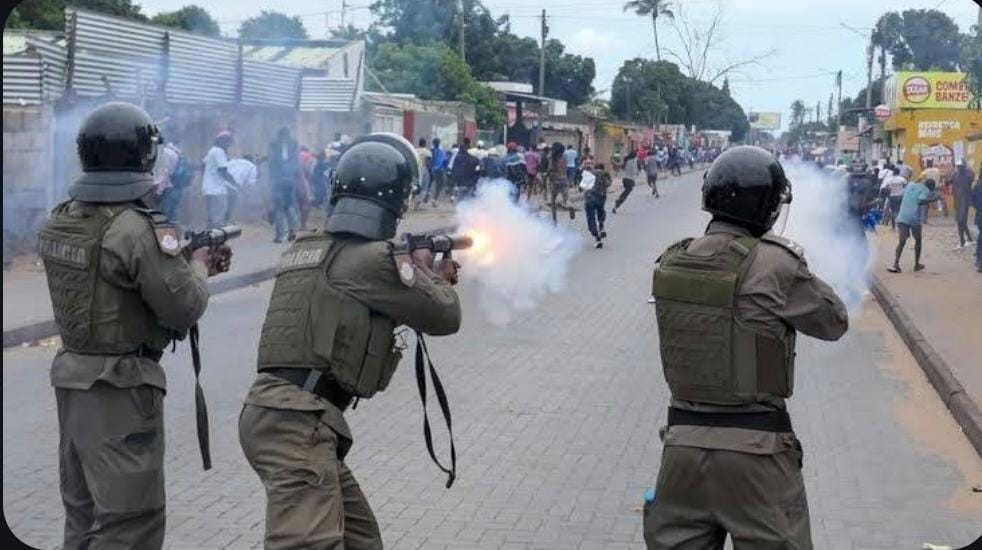
Mozambique has been here before. During the post‑election demonstrations, several citizens were killed by police in circumstances that raised serious questions about proportionality and legality. Protesters were shot in the streets. Others died in custody. Families waited for answers that never came. The institutions responsible for protecting life responded with defensive statements and promises of investigations that rarely led to accountability – only some weeks ago, police shot dead demonstrators in the central province of Tete, and the northern province of Nampula, and there has yet to be a satisfying institutional explanation.
The Xinavane case fits into this same troubling continuum. The press release emphasises the suspect’s alleged criminality, painting him as a figure “considered highly dangerous to the public.” But even the most dangerous suspect is entitled to due process. The law does not permit summary execution. The moment an officer fires four bullets into the head of a man who is already restrained, the boundary between policing and killing collapses.
The police statement attempts to strike a balance – acknowledging “overzealous conduct” while reaffirming commitment to legality. But the language is careful, almost hesitant. It does not confront the core issue: that a citizen died in a manner that violates every principle of proportionality and human rights the PRM claims to uphold. The promise of an investigation is familiar, but history has taught Mozambicans to be sceptical. Investigations often fade quietly, and officers rarely face meaningful consequences.
This is the essence of police impunity. It is not only the act of killing; it is the institutional response that follows: the framing of the victim, the minimisation of the violence, the absence of accountability. When impunity becomes routine, it reshapes the social contract. Citizens begin to fear the police instead of trusting them. Communities withdraw cooperation. The rule of law becomes fragile, almost symbolic.
The Xinavane killing is not just a tragedy; it is a warning. It shows how quickly lethal force can be normalised when institutions fail to confront their own abuses. It shows how the logic used to justify killings during the post‑election unrest can be applied to any citizen deemed undesirable. And it shows how dangerous it is when the state’s monopoly on violence is exercised without restraint.
Mozambique cannot afford to look away. The press release, with its careful phrasing and promises of inquiry, is not enough. What is needed is transparency, accountability, and a clear public stance that extrajudicial killings will not be tolerated, not in Xinavane, not during elections, not anywhere.
Until that happens, the fear that police can kill with impunity will remain painfully real.
@2026, Mozambique Insights. All Rights Reserved