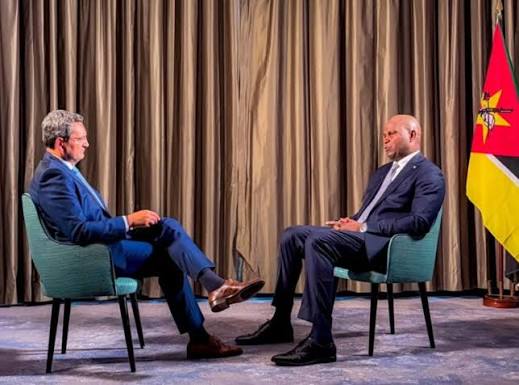
The military junta currently governing Guinea‑Bissau has sharply rejected recent criticism from Mozambique’s President, Daniel Chapo. Chapo voiced his concerns during an interview with RTP, Portugal’s public radio and television broadcaster, while on an official visit to Lisbon. In that interview, he condemned the arrest of a prominent opposition figure in Guinea‑Bissau, Domingos Simões Pereira.
In response, on 17 July, the junta’s National Transition Council issued a statement, dismissing Chapo’s remarks as hypocritical, arguing that he lacks the moral authority to comment on governance issues while Mozambique continues to face internal conflict and terrorist activity.
The Junta also reminded Chapo that he himself had faced a humiliating inauguration – abandoned by most CPLP (Community of Portuguese Speaking Countries) leaders, saved only by Guinea‑Bissau’s president who deigned to show up. So, turning that solidarity into public criticism felt, to them, like sheer ingratitude.
The exchange comes amid ongoing instability following Guinea‑Bissau’s November 2025 coup d’état, which interrupted the country’s democratic process. Since the coup, relations between the junta and the CPLP have remained tense, with the military authorities rejecting what they describe as external interference in domestic affairs.
Comment
An observer told Mozambique Insights that President Chapo’s comments on the Guinean political crisis amounted to “a tremendous diplomatic mistake”, arguing that Chapo underestimated the geopolitical sensitivities of West Africa, a region where institutional rivalries between the CPLP and ECOWAS (Economic Community of West African States) are longstanding and widely recognised.
The rivalry between the CPLP and ECOWAS comes from the way both end up stepping into Guinea‑Bissau’s frequent crises. ECOWAS sees itself as the region’s main guardian of political stability, while the CPLP feels a duty to speak up for its lusophone members. That overlap creates friction, made sharper by lingering suspicions that the CPLP echoes Portuguese influence and by the personalities tied to it. Years of instability have only hardened these feelings, leaving a quiet, enduring tension between ECOWAS’s more forceful regional role and the CPLP’s softer, symbolic diplomacy.
The observer said that Chapo “did not realise he was speaking from Lisbon” and, in doing so, inadvertently echoed an agenda that many West African governments associate with Portugal. The observer added that Cape Verde, with its closer understanding of regional dynamics, has been careful to avoid public pronouncements on the Guinean crisis for precisely this reason.
The source recalled that Pereira built a significant part of his international career as Executive Secretary of the CPLP, which makes any commentary from another lusophone head of state particularly delicate. In this context, the observer believes Chapo would have been better served by adopting a more cautious and institutional tone, limiting himself to defending “strong, durable institutions capable of guaranteeing stability”, rather than giving the impression that he was speaking on behalf of a CPLP‑ or Portugal‑aligned agenda.
Incidentally, at ECOWAS’s recent summit, the regional bloc made no public reference to Pereira. This silence suggests that ECOWAS prefers to handle the matter through its own diplomatic channels, said the observer. “In West Africa, ECOWAS is regarded as the principal actor in resolving political crises in the region, whereas the CPLP’s influence is considerably more limited”.
Taken together, these interpretations place the current diplomatic friction within a wider historical and institutional context. This is more than a simple exchange of accusations; it exposes the old tensions between regional blocs, the sensitivities of lusophone diplomacy, and the competing ideas of legitimacy that shape politics in West Africa, and Chapo walked straight into that trap.
@2026, Mozambique Insights. All Rights Reserved