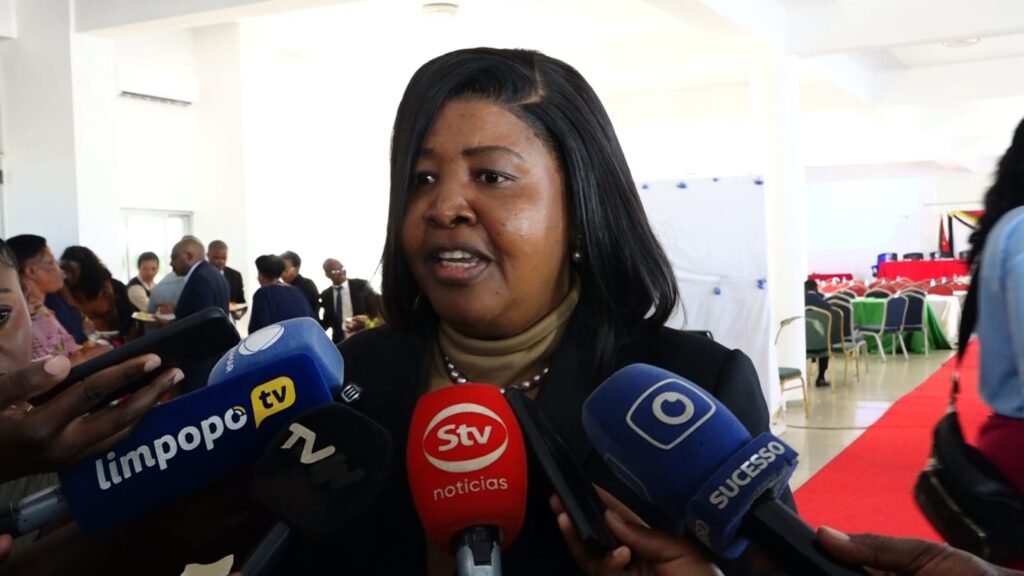
Two weeks ago, the governor of the southern province of Gaza, Margarida Mapandzene, resigned from office, citing “professional and personal reasons”.
Asked about the move, President Daniel Chapo stated that he was unaware of the motivations behind the decision, noting that only the former governor herself can clarify the circumstances.
The resignation followed the suspension of all provincial Frelimo party bodies, which triggered a process of internal restructuring, amid factional disputes and the political shock of the misappropriation of food aid by several Gaza politicians at the height of the flooding in January.
Under Mozambique’s Law on Local State Organs, a governor’s resignation triggers an interim arrangement in which the President of the Provincial Assembly temporarily assumes the role until a new appointment is made. The transition has already been resolved. Alfeu Constantino Cuna, a Frelimo member of the Provincial Assembly, has been formally appointed as the new governor of the province.
Comment
Mapandzene’s resignation came at a sensitive moment for Gaza. The provincial structures of Frelimo were suspended in late May, opening a period of internal reorganisation within the ruling party. Her departure also followrd a scandal involving the misapporpriation of goods intended for victims of the floods in Xai Xai, a case that resulted in the detention of several individuals linked to Frelimo, including a municipal official.
The resignation cannot be understood in isolation. Her phrasing, “professional and personal reasons”, echoes the language used by the current governor of Zambézia, Pio Matos, when he stepped down as mayor of Quelimane in August 2011. At the time, Matos claimed he was dealing with mental health issues. The public, however, interpreted his words as a coded admission that he had been forced out. The political consequences were lasting: Frelimo has not won Quelimane since.
This pattern suggests that Frelimo politicians have developed a rhetorical formula for exits under pressure. By invoking personal or health related reasons, they comply with party discipline while signaling to the public that their departure was not voluntary. Mapandzene’s resignation fits neatly into this tradition.
The timing is equally telling. President Daniel Chapo and his secretary general, Chakil Abubacar, are in the process of consolidating power ahead of Frelimo’s 2027 congress. Their strategy has involved gradually purging party ranks and replacing them with loyalists. In this context, Mapandzene’s removal appears less a matter of personal choice than part of a broader campaign to tighten control over the party’s most strategic bastions.
Gaza, long considered Frelimo’s electoral fortress, has been at the centre of repeated controversies over voter registration, inflated rolls, and disputed results. It is also the province where the overlap between party and state is most visible. Any change in leadership there is inevitably read as a reflection of internal power struggles.
Mapandzene’s resignation, therefore, is not simply administrative. It is a political signal. Formally, she resigned. In reality, she was pushed. And her departure underscores the ongoing reshaping of Frelimo’s internal landscape, as Chapo and Abubacar prepare the ground for the party congress by ensuring that the provinces are firmly in the hands of their loyalists.
Furthermore, the swift appointment of Cuna underscored both the urgency of stabilising Gaza, a province central to Frelimo’s electoral machinery, and the broader process of consolidating loyalists in key positions.
@2026, Mozambique Insights. All Rights Reserved